
….but not very far beyond to be honest, as although we booked a five night break, we didn’t actually venture much beyond the self imposed “ten mile from” Chichester rule – partly because at 90 degrees (32 Celsius for any modernists out there) we considered it an ethical victory to simply avoid evaporating in the ‘melting pot’ (shout out to Blue Mink, although both the group and the song are probably cancelled by now 🫨). In addition, we went down by train (astonishing I know) and it meant we were reliant on train, bus and taxi whilst there. It all proved to be fine though, despite a couple of minor train alterations because of the heat.
The Harbour Hotel proved to be a very good choice – we were booked in to a nice junior suite but the age of the building precluded air conditioning in the rooms so it was unbearably hot, although fans were provided; we knew when we booked, so not a surprise but we could have done without the hottest June on record, but hey ho, we managed – the hotel bar and restaurant were air-conditioned however, so drinks and meals were always comfortable and the food was first class.
We decided to hit one of the ‘must sees’ on the first full day, so on Tuesday we strolled down to the rail station after breakfast and got day tickets to Arundel to visit Arundel Castle, which had long been on Mrs. No Name’s wish list and, of course, a castle and I should never be parted so a bit of a no brainer really.
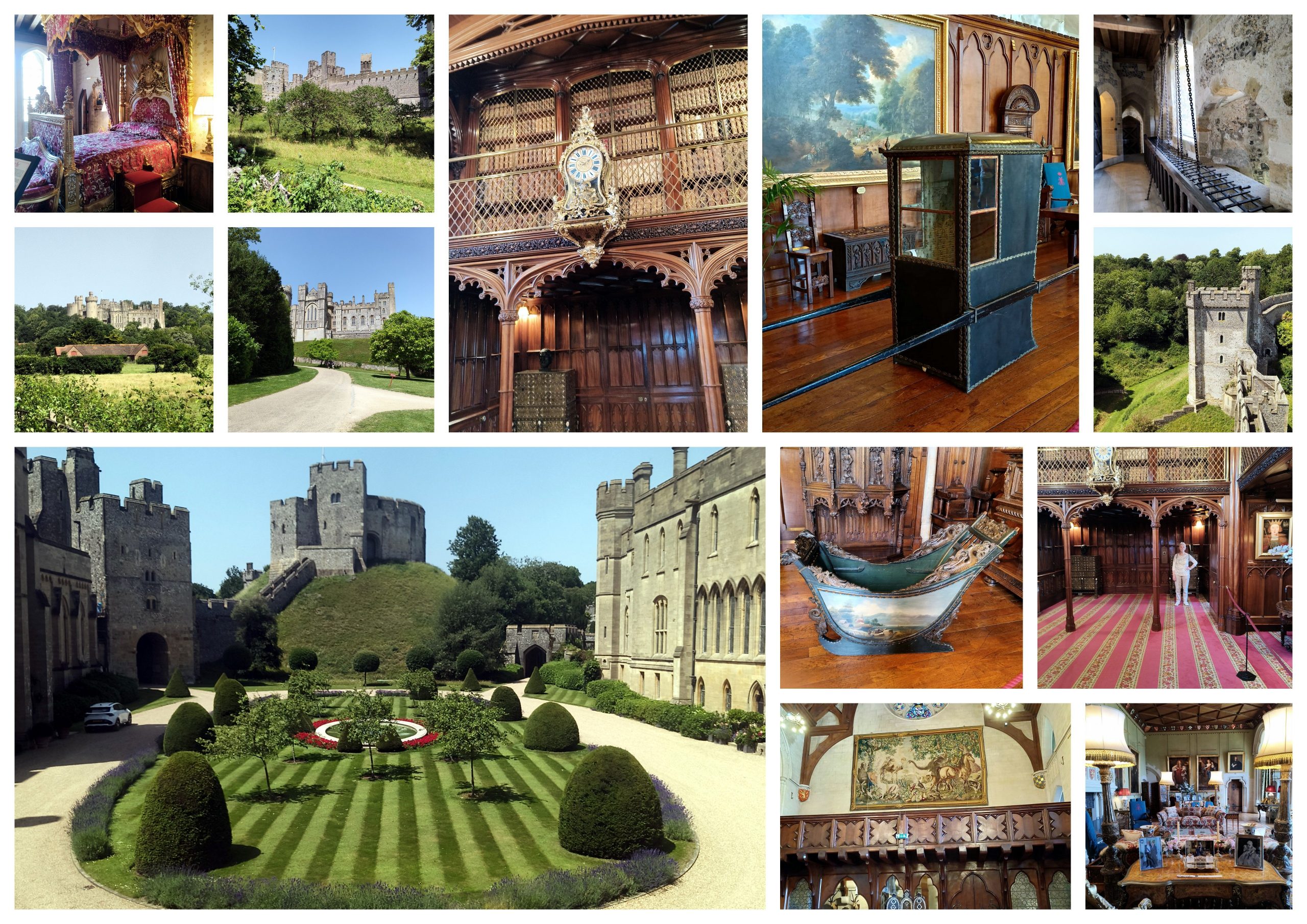
The building is actually a restored and remodelled medieval castle. It was established by Roger de Montgomery in the 11th century. The castle was damaged in the English Civil War and then restored in the 18th and early 19th centuries by Charles Howard, 11th Duke of Norfolk (Norfolk I hear you cry…..see below). Further restoration and embellishment was undertaken from the 1890s by Charles Alban Buckler for the 15th Duke. The results of all this history are concentrated at the Castle, which houses a fascinating collection of fine furniture dating from the 16th century, tapestries, clocks, and portraits by Van Dyck, Gainsborough, Mytens, Lawrence, Reynolds, Canaletto and others. Personal possessions of Mary, Queen of Scots and a selection of historical, religious and heraldic items from the Duke of Norfolk’s collection are also on display.
We enjoyed the whole experience, although we could have done without the impromptu fire alarm, which meant a delay in the baking sun instead of the cooling ice cream we had just started in the castle café. Hopefully the collage gives a little insight into the building, with clearly delineated old and new sections. Interesting that it is the home of the Duke of Norfolk, which seems a little odd geographically until you discover it is one of many such establishments that pass to families through marriage – in this case the union of the daughter of Henry Fitzalan, (12th Earl of Arundel) Mary Fitzalan to Thomas Howard, 4th Duke of Norfolk in 1555, to whose descendants the castle and earldom passed. Surprisingly we did manage to climb the keep to get views of Chichester Cathedral and beyond, which we were to visit later.
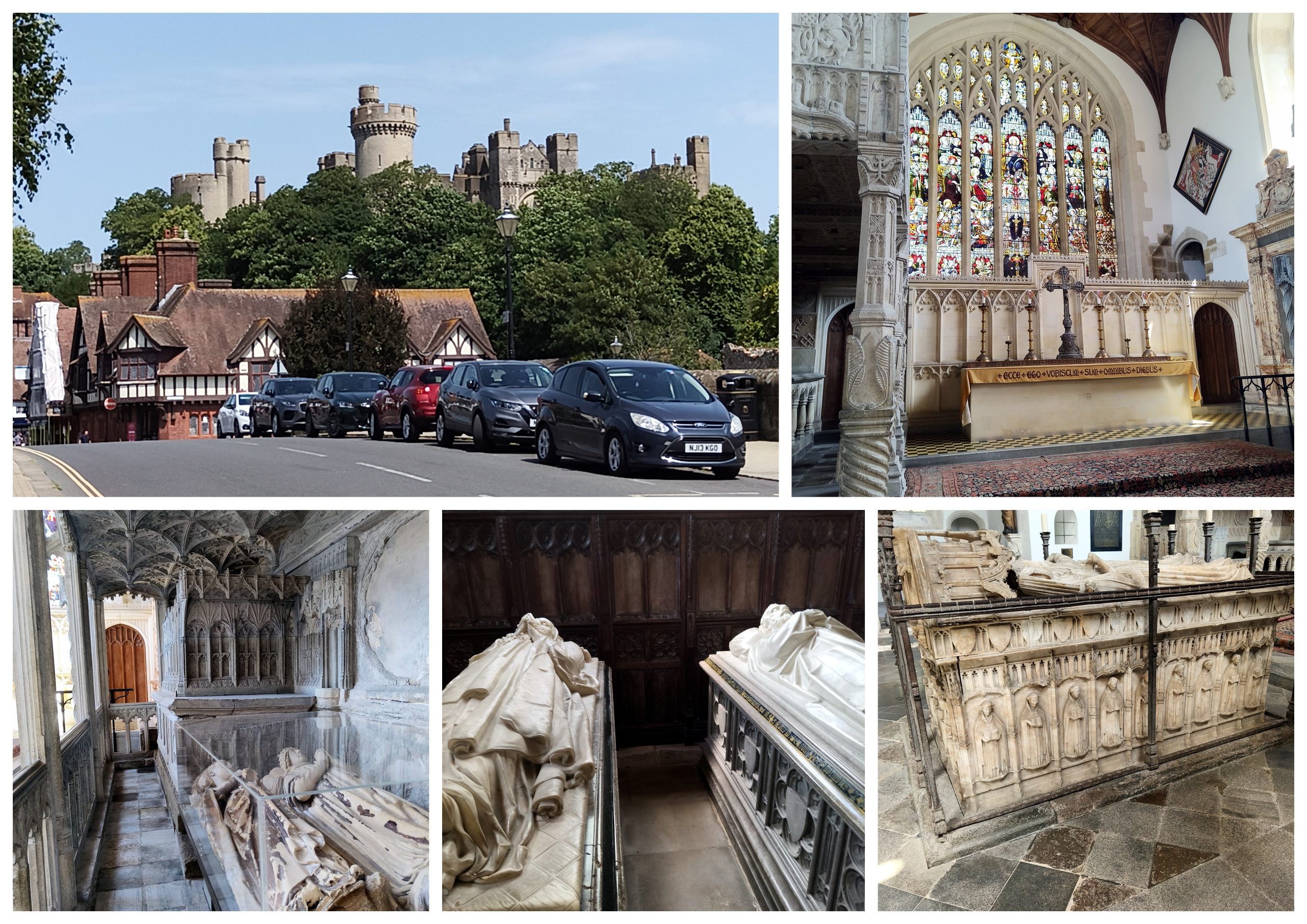
Later (see what I did there), we left the castle and strolled up the the Cathedral, which I found interesting if a little ordinary, which I guess makes me an outlier as it is classified by Historic England as a Grade I listed building (buildings of exceptional interest). Apparently, it was dedicated in 1873 as the Catholic parish church of Arundel and it became a Roman Catholic cathedral at the foundation of the Diocese of Arundel and Brighton in 1965. It now serves as the seat of the Bishop of Arundel and Brighton.
However, before leaving the castle grounds (should have done this first if I had been even a little structured in my presentation) we also visited the Fitzalan Chapel, which is the chancel of the church of St Nicholas in the western grounds of the Castle. Dating to the 14th century, the chancel is used as the private mausoleum of the Fitzalans and later the Howard family. The church is one of the very few that is divided into two worship areas, a Catholic area (the chancel) and an Anglican area (the nave and transepts). It is a Grade I-listed building. A number of noted Fitzalan and Howard family members are buried in the chapel, many in tombs adorned with sculpted effigies. Most of the recently deceased Dukes of Norfolk are buried there and in many ways it was as fascinating as the castle itself. Finally, after sampling one of the many bistros to be found in the town centre we took the short journey back to Chichester via Barnham, which appeared to be something of a hub for changing trains, even for relatively short distances.
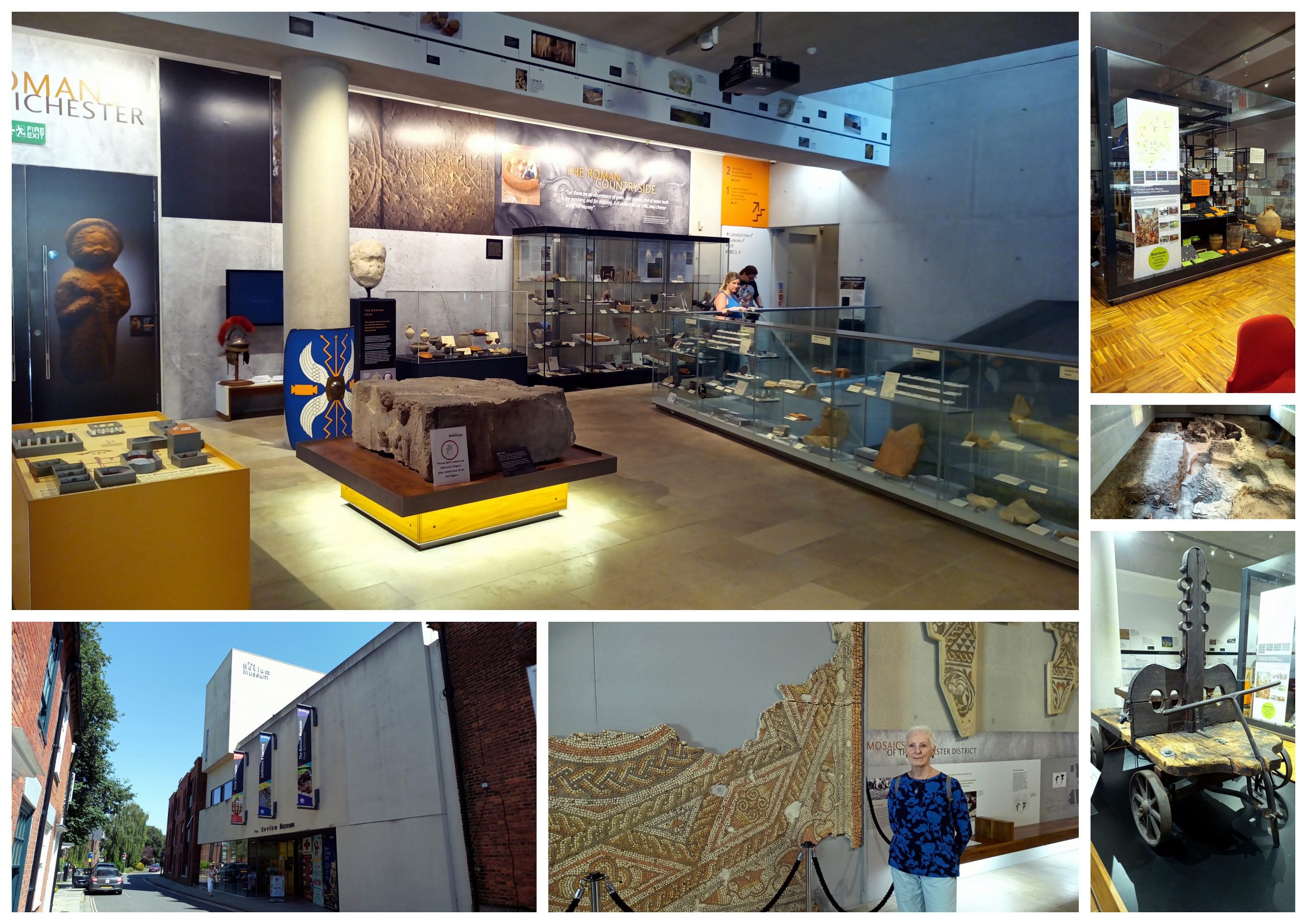
Despite being even hotter the next day, we courageously ventured out again, but straight to the Novium Museum. The building is divided into three floors, each of which contains a gallery for exhibitions. It contains a research and learning room as well as a collection store for the social history collection. The museum is built directly over the top of the remains of Chichester’s Roman Bath House complex, which are displayed in the ground-floor gallery.Given it is built around a Roman site, it would be rather churlish to argue about its physical location. It also had the added benefit of air conditioning. Definitely worth a detailed look around, with other floors dedicated to various aspects of Chichester life.
Mrs. No Name then took off for a vist to the Pallant House Gallery, which shares the story of British art from 1900 to the present. Artists such as Barbara Hepworth, Graham Sutherland, Paul Nash, Rachel Whiteread, Damien Hirst, Barbara Walker and others are apparently all to be found exhibited there.
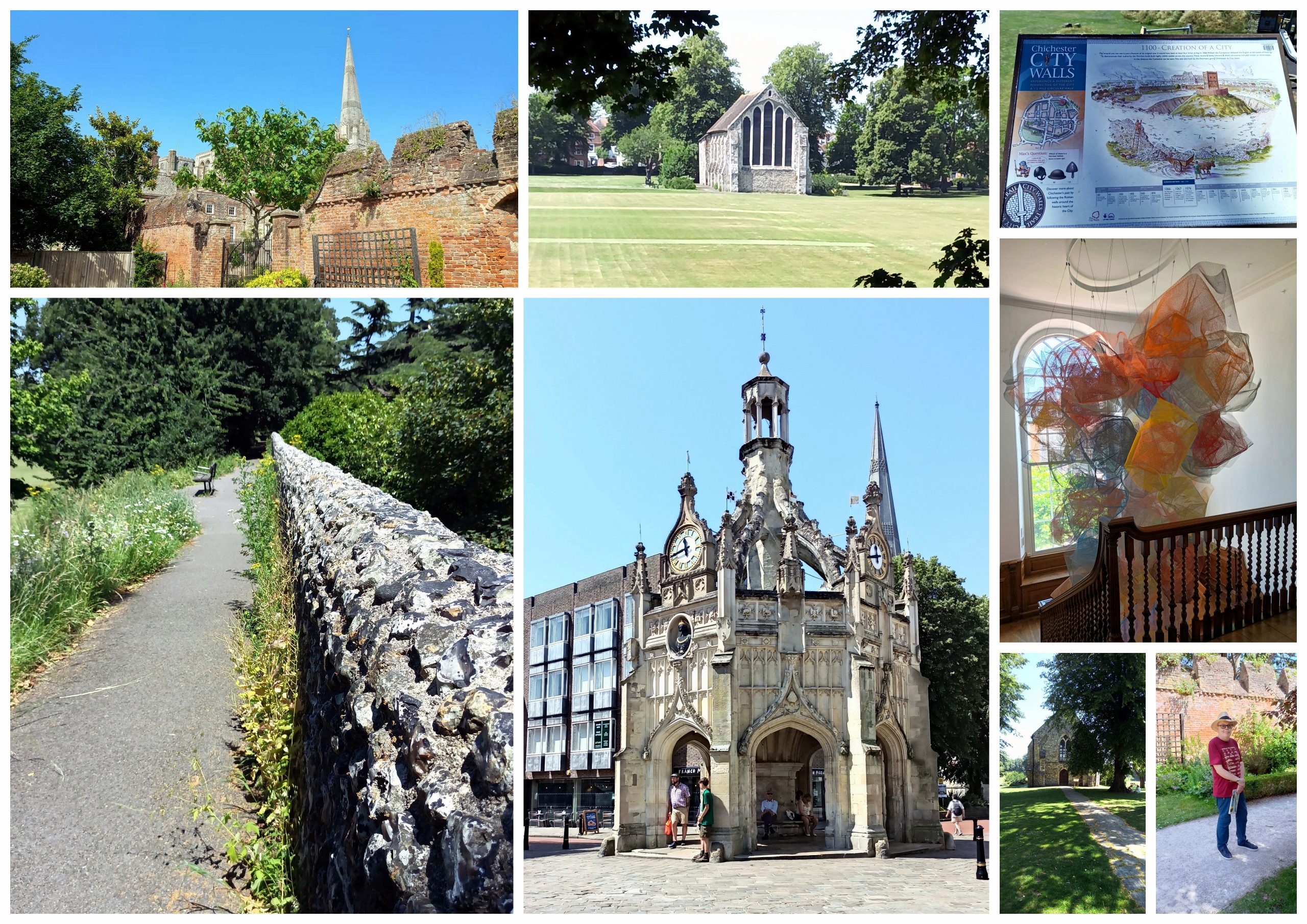
It was too hot for me though, so I decided on a wander around the town, calling in at the ‘Hole In The Wall’ for a quick pint (excellent) from the many on tap. Took a walk along a section of the old walls, which fortuitously stretched around the perimeter of Priory Park, so the stroll also took in the old priory that now doubles as the Guildhall. It’s a little understated, but is in fact a magnificent example of late 13th-century architecture and is one of the few Franciscan Friaries in England that is still roofed.
We eventually made it to Chichester Cathedral around mid afternoon – two earlier attempts were thwarted because there were a couple of local performances taking place; no bad thing by the way!!. The cathedral is formally known as the Cathedral Church of the Holy Trinity and is the seat of the Anglican Bishop of Chichester. It was founded as a cathedral in 1075, when the seat of the bishop was moved from Selsey. Why Selsey in the first place? No, me neither….but I do know it’s only around eight miles from Chichester.
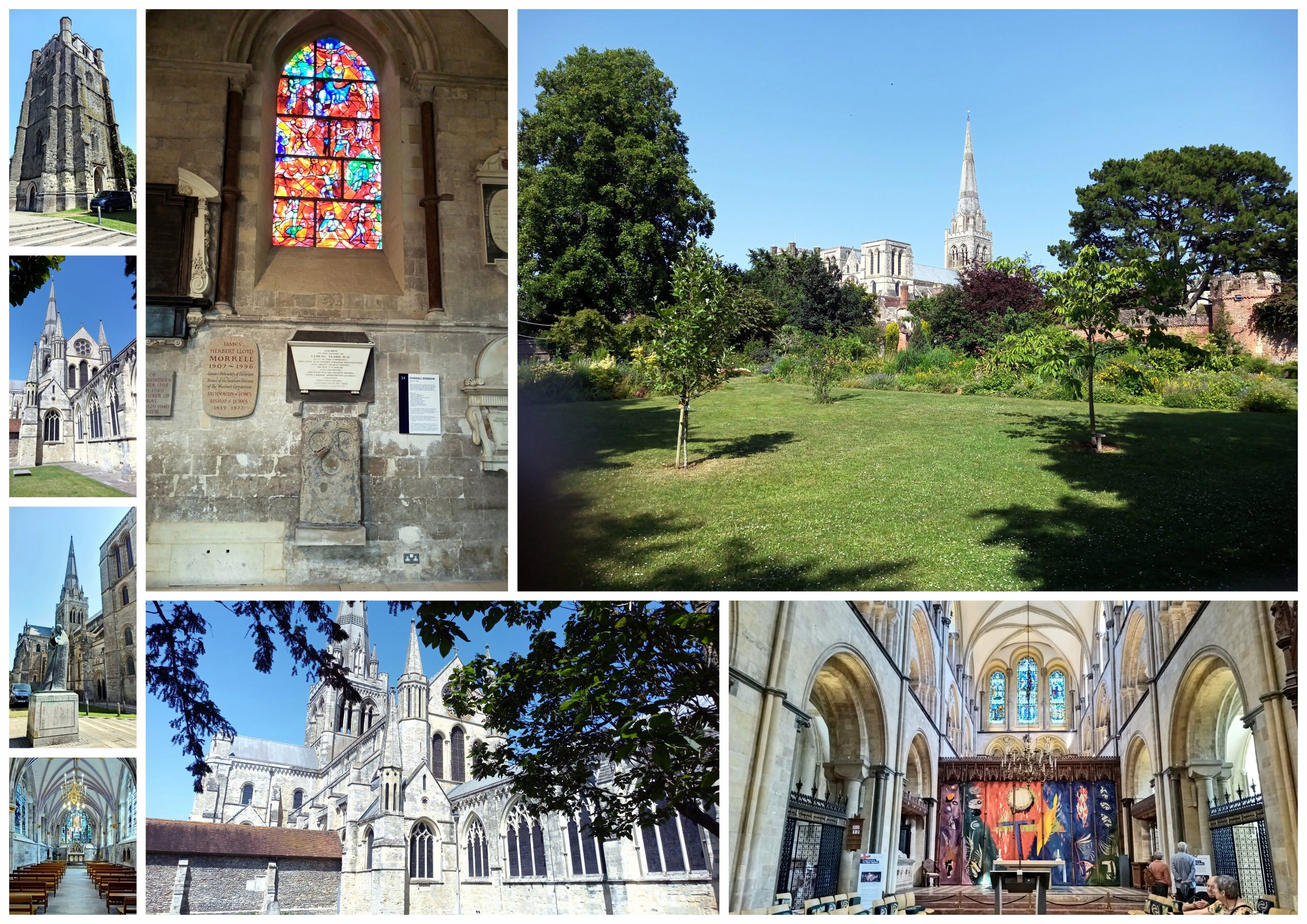
The building has two architectural features that are unique among England’s medieval cathedrals—a free-standing medieval bell tower (or campanile) and double aisles. The cathedral also contains two rare medieval sculptures, and many modern art works including tapestries, stained glass and sculpture. Of particular note, in my view, is the stained glass window by Marc Chagall and the remains of a Roman mosaic pavement (seen under the cover of glass). All to be seen, I think, in the collage, except the mosaic pavement, which I have startlingly failed to include for some reason. All that and peregrine falcons roosting in the building’s exterior. Finally, and also worthy of trivial note, the spire of Chichester Cathedral is the third tallest in England and acts as a landmark for travellers. It is the only spire from a medieval English cathedral that is visible from the sea. Come on, that’s surely worth hiving away for any potential future pub quizzes!!
The next morning we spent pottering about the town centre, which it has to be said is very pleasant and pedestrianised in all areas where it’s practical or feasible. Never pottered in so many shops on a city break before and surprisingly enough all the ones we chose to grace with our presence were air conditioned – purely coincidental he states with a nose that seems longer than Pinocchio at the moment!
The leisurely morning was followed by a matinee production at the Chichester Festival Theatre ‘complex’. It wasn’t at the Festival Theatre itself but at the newer Minerva Theatre (opened in 1989) where we had booked to see a production called “45 Years” starring Gabriel Byrne and Geraldine James, based on a film by Andrew Haigh and adapted for the stage by Hannah Patterson. The film had passed me by and it was booked largely on the two lead actors and it has to be said we were not disappointed – they were both compelling and it was a treat to see the pair at work up close. Kudos to Gillian Bevan as well, who had a supporting but pivotal tole in this profound yet simple storyline.
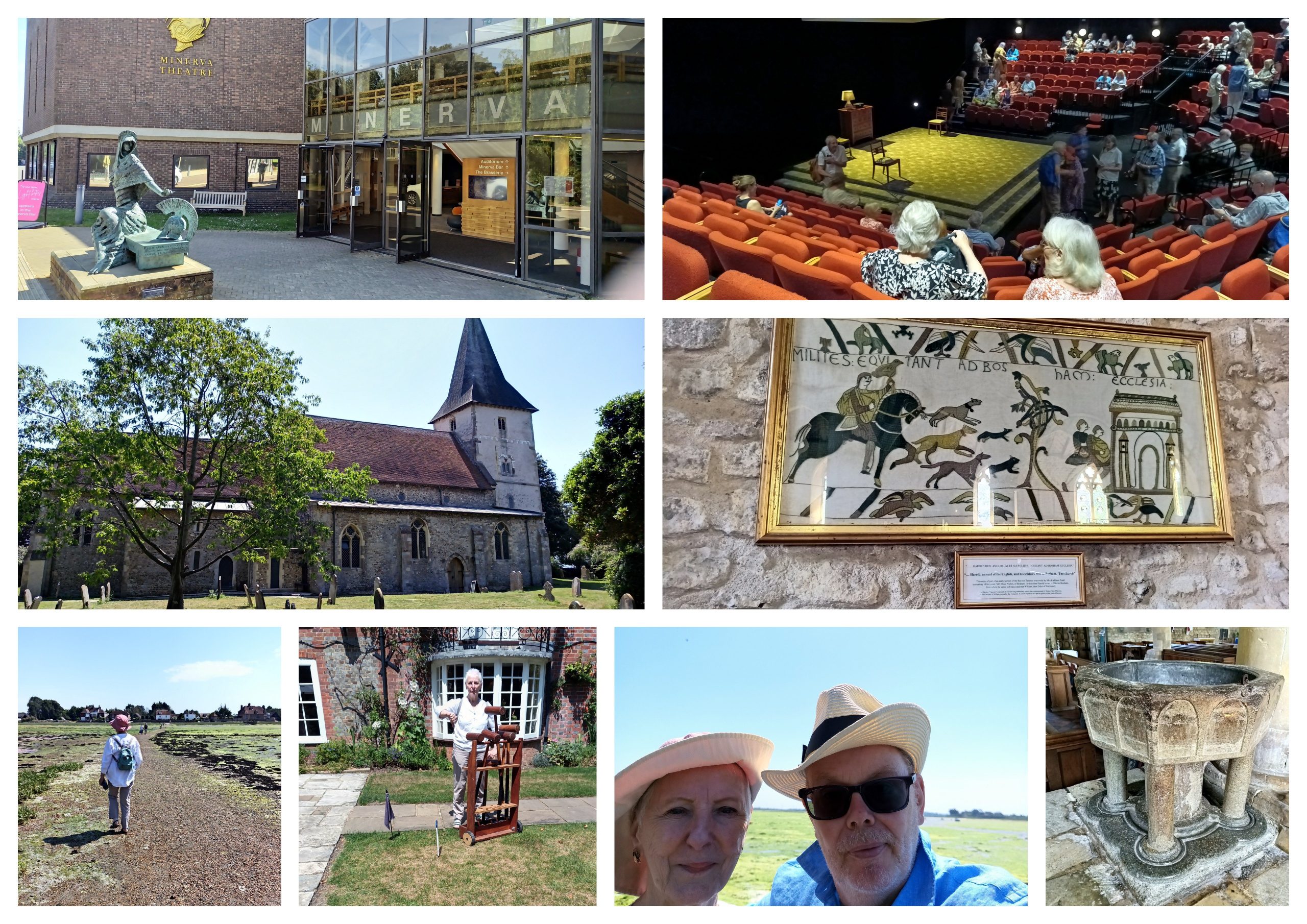
On the final day we took a taxi to Bosham and particularly to the Millstream Hotel (on the recommendation of a loving but now departed friend of Mrs. No Name), which was about five or six miles away. After a quick coffee and biscuit refreshment stop and a quick game of croquet on the hotel lawn (I’ll make a point of not referring to the victor, thereby in essence of course telling you who won) we took a walk down to the village and estuary, which we both thought lovely. We wandered along the waterfront and then headed for the Holy Trinity Church, the oldest site of Christianity in Sussex where people have worshipped for over 1,300 years. Of particular architectural note were the Norman window, the Crusader Crosses, the Norman Font (late 12th century) and the 11th Century Chancel Arch. The small crypt wasn’t built until the 14th century and was ‘probably’ not a place of worship but more likely a repository for bones. There is a lot of speculation about Bosham, including the story of King Canute’s daughter drowning and being buried in the Church; in 1865 a small coffin was unearthed but, despite the protestations of historians, I suspect the rest is pure speculation, but then that is all part of the village charm. There is a tapestry in the church however, which shows a section where Harold (later King Harold) is seen entering the church ahead of his sailing to Normandy in 1064 – so that is at least (probably) true! Excellent, humungous sandwiches in a local cafe and then back to Chichester via a luckily timed local bus.
We enjoyed the whole stay, despite the incredible heat. The evening meals in the hotel were a particularly fine standard and worth mentioning and, although the heat caused some disruption to our journey home (involving a change at the aforementioned Barnham), it didn’t unduly cause us oldies too much in the way of inconvenience.