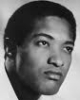
One of the ‘younger generation’ of players (although in Blues, the younger generation are often well into their 40s, 50s and beyond) Walker was born in San Francisco, California. His eclectic musical interests have taken a long time to develop into a cogent musical personality of their own – at one point, he even quit the blues and formed a gospel quartet.
Many would argue that he was the link between the old and new, between blues and the early days of rock & roll and many more might argue he wasn’t really a blues artist at all. Whatever your stance, ‘Big’ Joe Turner (born Joseph Vernon Turner) had a long and varied career and is one of the Primer’s favourite artists. He teamed up with Pete Johnson, the boogie woogie pianist, early on in his career and their professional relationship lasted around 40 years.
Definitely one of the best of the contemporary bluesmen – an artist who can draw new recruits to the blues in a way other exponents of the genre might not. Garner has a natural talent for storytelling and a singular approach to music making; he isn’t really content to try and find a personal interpretation of traditional or prevailing influences or existing blues styles.
Little Milton made his first serious impact when recording for Chess/Checker in the mid to late 60s, having signed to the label in 1961. One of the great artists who effortlessly adapted the blues form to the influence of soul in many of his recordings, he easily straddles both camps, but his guitar playing certainly keeps him within the blues spectrum. One of the Shades favourites, probably because he was/is an R&B vocal stylist in the mould of all time hero Bobby Bland.
A particular favourite of the Primer, even if some of his material over the years has been less than inspired. An entry in the Primer primarily because of his varied approach rather than seeing it as a potential drawback. Rawls was born in Chicago in 1935, and he has recorded in a variety of styles over the years – jazz, straight pop, Philly soul, flirted with disco and most recently back to the jazz / blues of his early years. Some have said that his performances are devoid of zest but this pre-supposes that all soul has to be delivered in the style of an Otis Redding or James Brown. This is patent nonsense and no-one can deny the the quality and distinctive nature of his wide ranging voice, nor his gospel roots and jazz inflected styling.
Now predominantly known, if known at all, as the ‘Queen Of Extreme’, her bawdy latter day raps and highly charged sex grooves, Millie Jackson is probably one of the most underestimated and neglected soul voices of the last 30 years. The lack lustre latter day career should not detract from some great work in the 70s and early 80s – it’s time for a little respect!
Mitty is now probably best remembered (if at all) for her truly exceptional ballad ‘I Had A Talk With My Man‘ – based on the James Cleveland gospel ‘I Had A Talk With God’ and recorded and released in 1965. But this stellar release is far from the complete story and the recent release of the Chess singles anthology on Kent records provides an appropriate opportunity to pick up on Collier’s career, especially her tenure at Chess records. She never really achieved that much in the way of commercial success and had Dusty Springfield not covered “I Had a Talk with My Man,” Collier would probably be even more obscure than she is.
An artist whose most famous record, the one with which he is most associated, was the first he ever recorded. But Percy Sledge should be appreciated for far more than ‘When A Man Loves A Woman’, even if the track did help shape southern soul and establish the great Muscle Shoals studios. One of the truly great voices of soul music.
One of the great innovators in popular music, it would be extremely remiss not to include him in an R&B Primer – so here he is!. An artist who managed to avoid record industry pigeon holing, he succeeded in any genre that he chose to address. One of the few who genuinely deserve the ‘genius’ tag, he provided a wealth of great material over a period of 30 – 35 years.
One of the younger generation of Blues players – it could be argued that Cray more than any other individual was responsible for the revival of guitar based blues that began in the 1980s. Another of the artists that the Primer admires who deviates from the pure Blues form – in his case by incorporating soul and rock influences – his vocals in particular are smoother than many of his contemporaries. He hit big in 1983 with the album “Bad Influence“, although he had recorded an earlier debut record (“Who’s Been Talking“) which was reissued on the back of the success of the Bad Influence set.
Born Ruth Alston Weston, ‘Miss Rhythm’ is perhaps best known by younger audiences through her role as DJ Motormouth Mabel in the John Waters film Hairspray; in the 1950s however, it’s not too extreme a position to suggest that the wonderful Atlantic Records label was built almost entirely around her early R&B successes. From around 1949 through to the end of the 1950s, Ruth had a string of R&B successes, although when the hits tried up in the early 60s, the industry was quick to forget about her as she worked as a domestic to make ends meet. Through Hairspray, her role in the Broadway revue Black and Blue and various appearances in TV sitcoms (yes really!) she gradually got herself back to the top of her profession, her status as a pioneer assured and acknowledged, not to mention her work advocating the rights and royalties of her musical friends and colleagues.
Included as one of the great pioneers, a man who took control of his own career, wrote much of his own material and paved the way for those who followed. He was also undeniably a superb vocalist and a forerunner for many of the talents for whom he both set the standard and broke down the boundaries of a still white dominated record business.